
How to Search Colorado Property Records by Owner Name, Address, or Parcel ID (Complete Guide)
Searching property records in Colorado is something many people try to do when they want to confirm ownership, check property details, verify a purchase, or simply understand more about a parcel of land. At first, it feels like it should be very simple you enter a name or address and instantly get all the information.
But in reality, Colorado does not operate like a single centralized property database. Instead, every county in the state maintains its own independent system for storing and managing property records. This is why the process can feel confusing at first, especially if you are not familiar with how county-level systems work in the United States.
The good news is that once you understand how these systems are structured, searching property records becomes much easier and very predictable. You just need to know what type of information you have owner name, address, or parcel ID and how each of these works inside county systems.
This guide will walk you through everything step by step in a practical, real-world way so you can confidently search any property record in Colorado without confusion.
Understanding What Colorado Property Records Actually Are
Before you start searching, it is important to understand what property records actually include, because many users assume they only contain ownership information. In reality, property records are a combination of multiple datasets maintained at the county level.
These records typically include the name of the current owner, the legal description of the property, parcel boundaries, assessed property value, tax-related details, and sometimes even sales history. In some counties, you may also see building details such as square footage, year built, and land use classification.
All of this information is maintained by the County Assessor or Property Appraiser’s Office. That means when you search for property records, you are not searching a private database or a random listing site you are directly accessing public government data at the county level.
This is also the reason why accuracy depends heavily on which county system you are using and how well you enter search information.
Why Searching Property Records in Colorado Feels Confusing
Most users struggle not because the data is missing, but because each county in Colorado uses a different system and interface. There is no single statewide website where all property records are stored in the same format.
One county might have a modern search tool where you can type an address and instantly see results. Another county might require exact parcel numbers or very specific formatting. Some systems are simple and user-friendly, while others are more technical and require multiple steps.
Another major source of confusion comes from how search inputs are handled. Even small differences in formatting such as abbreviations in street names, missing directional indicators, or incorrect spacing can affect whether a property appears in the results or not.
Because of these inconsistencies, users often assume that the property record does not exist when in reality the search method simply does not match the system’s requirements.
Method 1: Searching Colorado Property Records by Owner Name
One of the most common ways to search property records is by owner name. This method is useful when you know who owns a property but do not have the exact address or parcel number.
When using owner name search, most county systems require you to enter the last name first. Some systems allow partial name searches, while others require exact spelling. This depends entirely on the county database structure.
Once the search is submitted, the system will display all properties associated with that owner within that county. In many cases, a single owner may have multiple properties listed, so you may need to carefully review each result to identify the correct parcel.
There is also an important limitation here. If the property is owned by a company, LLC, or trust, the name may not appear in a simple way. Instead, it may be listed under a registered business entity, which can make it harder to identify at first glance.
This method is helpful for general lookup, but it is not always the most precise way to locate a single property.
Method 2: Searching Property Records by Address
Searching by property address is the most intuitive method for most users because it works the same way people search for locations in everyday life. However, in county systems, address-based search is more strict than people expect.
In many cases, the address must match exactly what is stored in the county database. Even small differences such as “Street” versus “St”, or missing directional indicators like North or South, can result in no search results.
Urban counties in Colorado usually have better address standardization, so searches tend to work more smoothly. However, in rural counties, addresses may not always follow a consistent format, which makes searching more difficult.
When the system does recognize the address correctly, it usually takes you directly to the property record page. This page includes ownership details, parcel information, assessed value, and sometimes even building and tax history.
If an address search fails, it does not necessarily mean the property does not exist. It usually means the system requires a different search method, such as parcel ID.
Method 3: Searching Property Records by Parcel ID (APN)
Parcel ID, also known as APN (Assessor Parcel Number), is the most accurate and reliable way to search property records in Colorado.
Every property in a county is assigned a unique parcel number. This number is used by the county to track land boundaries, ownership, taxes, and legal records. Unlike owner names or addresses, parcel IDs do not change when property is sold or transferred.
When you search using a parcel ID, the system directly pulls up the exact property without any confusion or matching errors. This is why professionals such as real estate agents, title companies, and county officials prefer this method.
If you already have the parcel number, this is always the best starting point because it removes ambiguity completely and ensures accurate results.
Colorado Property Records Search Methods (Quick Guide)
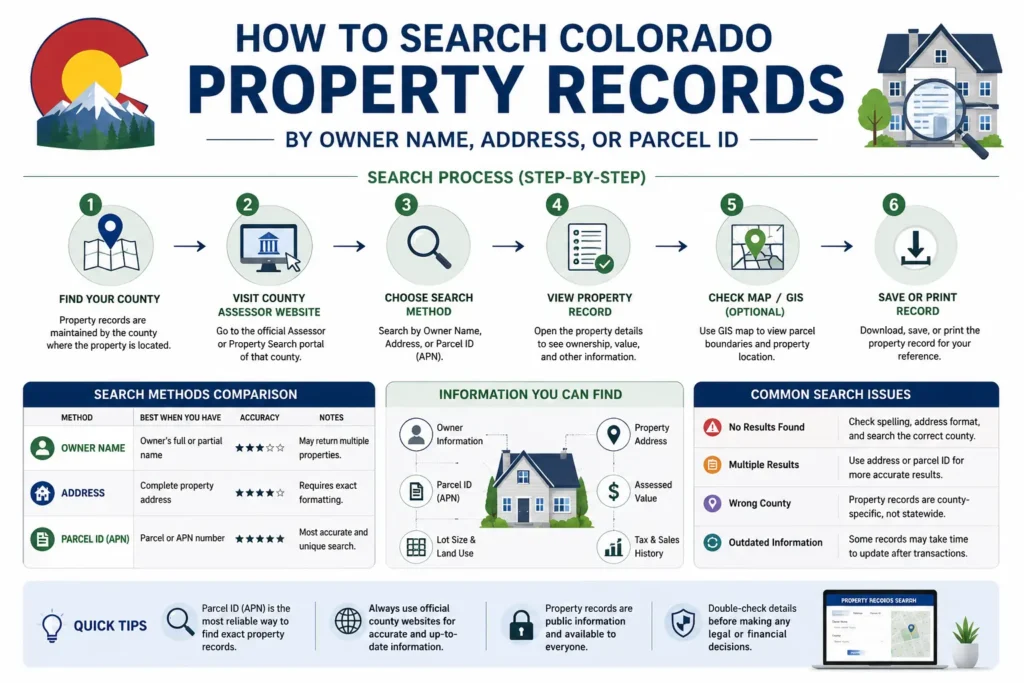
| Search Method | Best When You Have | Accuracy Level | Notes |
|---|---|---|---|
| Owner Name Search | You know current or past owner | Medium | May show multiple properties or LLC names |
| Address Search | Full property address available | High | Needs exact formatting (St, Ave, N/S etc.) |
| Parcel ID (APN) Search | Parcel number available | Very High | Most accurate method, used by professionals |
Step-by-Step Process to Search Property Records in Any Colorado County
Even though each county uses its own system, the overall process remains very similar across Colorado.
The first step is identifying the correct county where the property is located. Property records are always stored at the county level, so using the wrong county system will never produce accurate results.
Once the county is identified, you need to open its official Assessor or Property Search website. This is the primary database where all property records are stored.
Inside the system, you choose your search method based on the information you have owner name, address, or parcel ID. Each method works differently, so selecting the correct one is important.
After submitting the search, the system will display a property record page. This page usually contains ownership information, parcel boundaries, assessed value, land classification, and sometimes sales history.
The final step is reviewing the data carefully and verifying it. If something does not match or appears incomplete, you can cross-check using the county GIS map or additional assessor tools.
📍 Real Example: How Property Search Works in Practice
To understand how this works in real life, let’s take a simple example.
Imagine you are searching for a property in Jefferson County, Colorado.
You would start by opening Jefferson County’s official property search system. If you are using an address, you would enter it exactly as it appears in official records. If the system does not return results, you would switch to parcel ID search, which is more precise.
Once the property appears, you open the record page, where you can see the owner’s name, parcel size, property value, and other related details.
The important thing to understand here is that the system is not complicated once you know how to navigate it. The challenge is only in understanding how each county formats its data.
Why Property Searches Sometimes Fail or Show No Results
One of the most frustrating situations users face is when they search for a property and get no results even though they know the property exists.
This usually happens for a few specific reasons. The first is incorrect formatting, especially in address-based searches. Small differences in abbreviations or spacing can cause the system to fail.
The second reason is searching in the wrong county database. Since each county operates independently, using the wrong system will always return empty results.
The third reason is outdated or incomplete address data, especially in rural areas where property records may not be fully standardized or digitized.
In most cases, the issue is not missing information — it is simply a mismatch between how the data is stored and how the search is being performed.
Common Mistakes People Make When Searching Property Records
Many users make the mistake of relying only on one search method, usually owner name or address, and assume the property does not exist when they cannot find it.
Another common mistake is not realizing that each county system is different. Users often expect the same interface everywhere, which leads to confusion when tools behave differently.
Some users also confuse tax systems with property record systems. While both are related, they serve different purposes and may not show identical information.
Understanding these differences makes the entire process much smoother and more predictable.
FAQ – Colorado Property Records Search
How can I search Colorado property records?
You can search property records through official county assessor websites using an owner name, property address, or parcel ID.
Can I search Colorado property records by owner name?
Yes. Most county property search systems allow searches by owner name, although results may vary depending on the county.
Is parcel ID the best way to find property records?
Yes. Parcel ID is usually the most accurate search method because it uniquely identifies a property.
Why can’t I find a property record?
Searches may fail due to address formatting issues, spelling errors, incorrect county selection, or outdated records.
Are Colorado property records public?
Yes. Property records are generally public and maintained by county assessor offices throughout Colorado.
Which county website should I use?
You should use the official assessor or property search website for the county where the property is located.